

Switch
Written by Fares Khelif.
Problem Statement
Solution
"NO SOLUTION" Case
- We can notice that the electricity moves diagonally, so we can mark the points between squares as the points where the electricity settles.
- Consider a checkerboard: squares with
(i+j)even are light, and(i+j)odd are dark.Since it is impossible to move from dark squares to light ones (or the opposite), any point with(i+j)odd is unreachable. As we start from(0, 0)where(i+j)is even, all odd-parity points are marked UNREACHABLE, as shown in the illustration :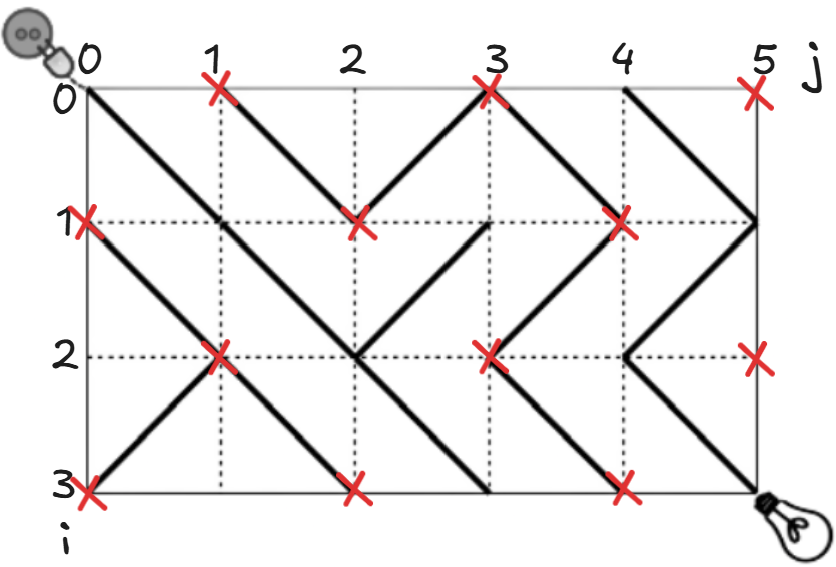
- So if ((n-1)+(m-1)) which simplifies to
(n+m)is odd, then the answer would be "NO SOLUTION".
Find the solution when it exists
- The cost to reach a point
[i, j]is the minimum over all incoming diagonals: previous cost + 0 if the tile already aligns, or +1 if it must be turned. So we can consider the whole circuit as a weighted graph, and the tiles as undirected edges, and the points between the squares as nodes. If the tile is ready to transfer the electricity from a point to another then the weight is 0, otherwise it's 1. - We can implement Dijkstra's algorithm to find the shortest path from the source to the lamp.
Implementation
cpp
#include <bits/stdc++.h>
using namespace std;
#define endl '\n'
using ll  = long long;
using pll = pair<ll, ll>;


void solve() {
    ll n, m; cin >> n >> m;
    vector<string> a(n);
    for (ll i = 0; i < n; i++) cin >> a[i];
    if ((n+m)%2==1) {
        cout << "NO SOLUTION" << endl;
        return;
    }

    vector<vector<vector<pair<ll, vector<ll>>>>> graph(n+1, vector<vector<pair<ll, vector<ll>>>>(m+1));

    for (ll i = 0; i < n; i++) {
        for (ll j = 0; j < m; j++) {
            if ((i+j)%2==0) {
                if (a[i][j] == '\\') {
                    graph[i][j].push_back({0, {i+1, j+1}});
                    graph[i+1][j+1].push_back({0, {i, j}});
                }
                else {
                    graph[i][j].push_back({1, {i+1, j+1}});
                    graph[i+1][j+1].push_back({1, {i, j}});
                }
            }
            else {
                if (a[i][j] == '/') {
                    graph[i+1][j].push_back({0, {i, j+1}});
                    graph[i][j+1].push_back({0, {i+1, j}});
                }
                else {
                    graph[i+1][j].push_back({1, {i, j+1}});
                    graph[i][j+1].push_back({1, {i+1, j}});
                }
            }
        }
    }
    vector<vector<ll>> ans(n+1, vector<ll>(m+1, 1e18));
    ans[0][0] = 0;
    priority_queue<pair<ll, vector<ll>>, vector<pair<ll, vector<ll>>>, greater<pair<ll, vector<ll>>>> pq; // {cost of reaching, x, y}
    pq.push({0,{0, 0}});
    while (!pq.empty()) {
        auto v = pq.top();
        ll w = v.first, x = v.second[0], y = v.second[1];
        pq.pop();
        for (auto c : graph[x][y]) {
            if (ans[c.second[0]][c.second[1]] > w+c.first) {
                ans[c.second[0]][c.second[1]] = w+c.first;
                pq.push({ans[c.second[0]][c.second[1]], {c.second[0], c.second[1]}});
            }
        }
    }
    cout << ans[n][m] << endl;
}
int main() {
    ios_base::sync_with_stdio(false);
    cin.tie(nullptr);
    //___________________________
    solve();
    return 0;
}
Time complexity Analysis
- The solution is implementing Dijkstra's algorithm, whose time complexity is
O(E * log V) - Since we have
(n+1) * (m+1)nodes, the complexity isO((n*m) log(n*m)), which is about4.4 * 10^6operations and sufficient for the constraints.